

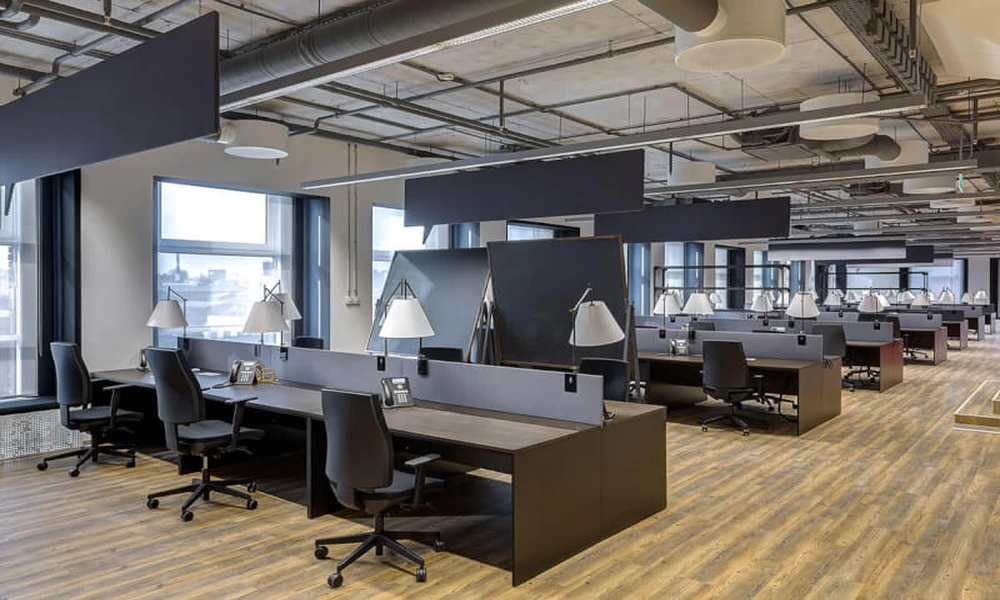
Desk-level partitions get treated as a smaller, simpler version of room dividers, when the actual design considerations are quite different: panel height relative to a seated line of sight, acoustic absorption at close range, and cable routing through a desk that a full-room partition never has to account for. Understanding what makes office desk partitions work well at the individual desk level, rather than assuming room-partition principles simply scale down, produces a more genuinely useful result.
Why Desk-Level Privacy Differs From Room Dividers
A room partition manages sound and sightlines across an entire zone, while a desk partition manages the much more specific problem of the person sitting directly opposite or beside a given desk, at a much closer distance and a fixed seated eye level. This difference in scale is why a scaled-down room partition often performs worse at a desk than a purpose-built desk panel.
Panel Height and Sightline Blocking
A panel roughly forty to sixty centimetres above desk height blocks the direct sightline between two seated colleagues without fully enclosing either desk, which is usually the right balance for reducing visual distraction while preserving a sense of connection to the rest of the floor. Taller panels increase privacy further but start to feel more like a cubicle than a desk.
Acoustic Panels for Reducing Desk Noise
Panels faced with a sound-absorbing fabric or foam core reduce the transfer of nearby conversation and keyboard noise meaningfully more than a plain laminate or glass panel of the same height, since absorption matters as much as physical blocking at this close range. Choosing acoustic material specifically for desk-level noise reduction, rather than assuming any panel material performs similarly, makes a real difference to focus.
Cable Management Built Into Desk Partitions
A desk partition with an integrated cable channel or grommet keeps power and data cables tidy and out of the way, which matters more at desk level than at room level since cables routed poorly at a desk are a constant, visible annoyance rather than a background issue. This is a small feature that materially affects daily user satisfaction with the partition long after installation.
Choosing Between Fixed and Freestanding Panels
Fixed panels, bolted directly to the desk frame, offer a cleaner look and cannot be knocked out of position, while freestanding panels can be moved or removed entirely as desk arrangements change, suiting an office where layouts shift periodically. The right choice depends on how often the specific desk arrangement is expected to change over the coming year or two.
Material and Fabric Choices for Sound Absorption
Fabric-wrapped panels absorb more sound than hard laminate but require more maintenance to keep clean, while laminate panels are more durable and easier to wipe down but reflect rather than absorb nearby noise. Balancing acoustic performance against maintenance practicality depends on how the specific office actually uses and cleans its furniture day to day.
Desk Partitions in Hot-Desking Environments
A hot-desking setup benefits from a lower, simpler partition style that provides some visual separation without personalising any single desk too heavily, since desks in this setup are used by different people from day to day rather than assigned individually. A partition style suited to assigned desks can feel oddly personal or restrictive in a shared, rotating environment, and a simpler, more neutral panel tends to suit a wider range of occupants over time.
Balancing Privacy With Team Visibility
Excessive privacy at every desk can undermine the collaborative visibility a team relies on for quick, informal communication, which is why some offices deliberately choose lower or more open partition styles for collaborative teams and taller, more enclosed styles only for roles genuinely requiring deep, uninterrupted focus. Matching partition style to actual team working patterns produces a better outcome than a single standard chosen for the whole floor regardless of role.
Retrofitting Partitions Onto Existing Desks
Adding partitions to desks that were not originally designed with them can be straightforward with a clamp-mounted system, though checking desk frame compatibility beforehand avoids a mismatch that requires an awkward workaround once the panels actually arrive. Retrofitting is generally cheaper than replacing desks outright to accommodate integrated partition systems.
Trialling a Panel Before Committing Office-Wide
A single desk fitted with a trial panel for a week or two reveals far more about how a specific team actually responds to added privacy than any specification sheet can, since the right height and material genuinely depend on the people using the desk day to day. Some staff find a given panel height reassuring while others find the same height isolating, and that response is difficult to predict reliably without simply trying it first on a small scale.
Getting the Focus-Privacy Balance Right
The right office desk partitions setup balances enough visual and acoustic separation to support focused work against enough openness to preserve a team’s natural collaboration, rather than maximising privacy for its own sake. Testing a single desk’s partition configuration with actual users before ordering across a whole floor catches a mismatch before it becomes an expensive, office-wide mistake.
